
LOG IN
Book a Free Trial
The Least Common Multiple (often called LCM) is a basic but very powerful idea in mathematics. When we talk about the least common multiple of two or more numbers, we mean the smallest number that is a multiple of all the numbers given.
It is also called the lowest common multiple. In math language, a multiple is what we get when we multiply a number by any whole number—so the multiples of 3 are 3, 6, 9, 12, and so on.
If a number appears in the list of multiples of more than one number, it is called a common multiple of those numbers. The smallest, or lowest, of those is the least common multiple.
For example, the multiples of 4 are 4, 8, 12, 16, 20, 24, etc. The multiples of 6 are 6, 12, 18, 24, 30, etc. 12 and 24 are common multiples of 4 and 6, but 12 is the smallest, so the LCM (or lowest common multiple) of 4 and 6 is 12.
Understanding the least common multiple is important because it helps us solve many everyday math problems, both in the classroom and in real life. The lowest common multiple is especially useful when working with fractions that have different denominators. In math class, you often need to compare, add, or subtract fractions like 1/4 and 1/6. To do this, you must create a common denominator, and the easiest way is to use the LCM of the two denominators. For example, the LCM of 4 and 6 is 12, so you convert both fractions to have 12 as the denominator: 1/4 becomes 3/12 and 1/6 becomes 2/12. Now you can easily add: 3/12 + 2/12 = 5/12.
The importance of knowing the lowest common multiple extends beyond fractions. It helps organize numbers when scheduling repeating events, like finding out when two friends will meet if one comes every 4 days and one every 6 days—LCM tells you they’ll meet every 12 days. LCM is also used in cooking with different measuring cup sizes, or in science when lining up cycles of events so things match perfectly.
In addition, understanding the least common multiple improves your problem-solving skills. You learn to break down challenges, identify patterns, and use logical thinking to find solutions. The concept is not just a math trick; it is a tool for making more complex calculations simpler, making everyday tasks smoother, and for solving puzzles in games, calendars, and even music rhythms.
By practicing how to find and use the LCM, you become more confident in handling numbers, working with fractions, and managing repeating schedules. Whether you are adding fractions, planning a party, or working on a math test, the least common multiple is a skill that makes math easier, more organized, and more fun!
There are a few ways to find the least common multiple for two or least common multiple of three more numbers. Here are the main methods used in elementary math:
Write down some multiples of each number.
Find the smallest number that shows up in both lists—the LCM.
Example: Find the LCM of 3 and 5 Multiples of 3: 3, 6, 9, 12, 15, 18, 21 … Multiples of 5: 5, 10, 15, 20, 25, 30 … Both lists have 15 as the lowest common multiple. So, LCM(3,5) = 15. Example: Find LCM(4, 6) Multiples of 4: 4, 8, 12, 16, 20, 24 … Multiples of 6: 6, 12, 18, 24, 30 … Common multiples are 12, 24 … So LCM(4,6) = 12.
Break each number into its prime factors.
Multiply together the highest power of all prime numbers present.
Example: Find LCM of 8 and 12
8 = 2 x 2 x 2 (2^3)
12 = 2 x 2 x 3 (2^2 x 3) Highest powers: 2^3 and 3 LCM = 2 x 2 x 2 x 3 = 8 x 3 = 24 So LCM(8,12) = 24.
Example: Find LCM of 10 and 15
10: 2 x 5
15: 3 x 5 LCM is 2 x 3 x 5 = 30
Write the numbers in a row.
Find a prime number that divides at least one of the numbers.
Divide and bring down the quotients.
Continue until all numbers are reduced to 1.
Multiply all the divisors used—the result is the LCM.
Knowing the lowest common multiple is not just for math class—here’s how you use it every day:
Scheduling: If two friends go running every 4 days and 6 days, they’ll meet after 12 days (LCM of 4 and 6).
Telling Time: The hour hand and minute hand on a clock meet every 60 minutes (LCM of 12 and 60).
School Events: If two class events happen every 3 and 5 days, both happen together every 15 days.
Recipes and Cooking: To find servings when using different cup measurements.
Music Beats: If two drum patterns repeat after different intervals, their lowest common multiple tells you when they will play together.
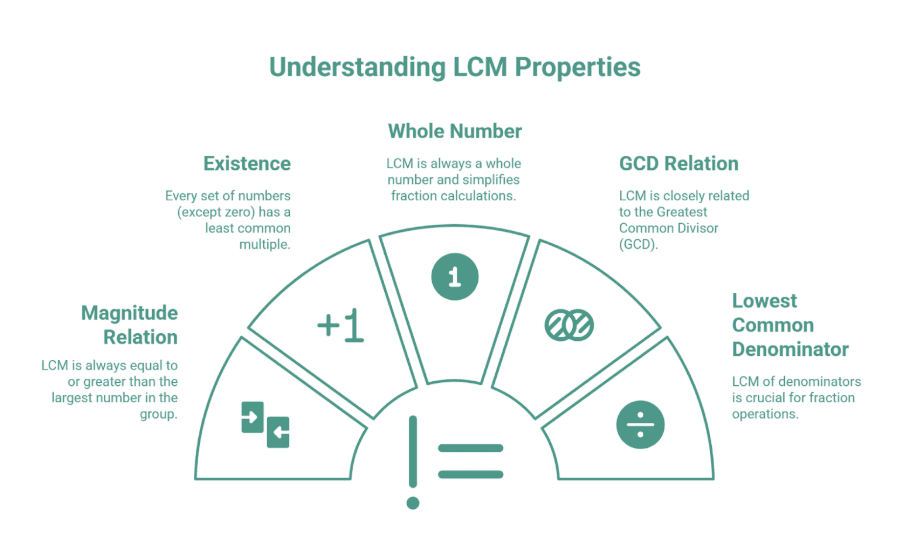
LCM is always equal to or greater than the largest number in the group.
Every set of numbers (except zero) has a least common multiple.
LCM is always a whole number and is used for making calculations with fractions easier.
The lowest common multiple is closely related to the Greatest Common Divisor (GCD).
LCM(a, b) = (a x b) / GCD(a, b)
The least common multiple of denominators is called the lowest common denominator and is important for adding and subtracting fractions.

The Least Common Multiple (LCM) is the smallest number that is a multiple of two or more numbers. This means it is the smallest number that both (or all) numbers can divide into evenly. The Greatest Common Divisor (GCD) is the largest number that divides two or more numbers exactly, without leaving a remainder.
For example, with the numbers 8 and 12:
LCM(8, 12) = 24 (because 24 is the smallest number that both 8 and 12 go into evenly)
GCD(8, 12) = 4 (because 4 is the biggest number that divides both 8 and 12 exactly)
In short, LCM is about finding the smallest shared multiple, while GCD is about finding the biggest shared divisor.
Try these problems to understand least common multiple better:
Find the LCM of 5 and 7.
Multiples of 5: 5, 10, 15, 20, 25, 30, 35 ...
Multiples of 7: 7, 14, 21, 28, 35 ...
Common multiples: 35, 70 ...
So, LCM(5,7) = 35
Find the LCM of 9 and 12.
Multiples of 9: 9, 18, 27, 36, 45, 54 ...
Multiples of 12: 12, 24, 36, 48 ...
Common multiples: 36 ...
LCM(9,12) = 36
Find the LCM of 15, 20, and 30.
Multiples of 15: 15, 30, 45, 60, 75, 90 ...
Multiples of 20: 20, 40, 60, 80 ...
Multiples of 30: 30, 60, 90 ...
Common multiple: 60 ...
LCM(15,20,30) = 60
More Examples with step by step- How to Find LCM of two numbers.
How To Find LCM of three numbers.
Adding or subtracting fractions with different denominators requires the lowest common multiple: To add 1/6 + 1/9:
Find LCM(6,9):
Multiples of 6: 6, 12, 18 ...
Multiples of 9: 9, 18 ...
LCM is 18.
Change both fractions to have denominator 18:
1/6 = 3/18
1/9 = 2/18
Add:
3/18 + 2/18 = 5/18
When learning about the least common multiple, students sometimes make mistakes that can lead to wrong answers. One common error is mixing up the greatest common divisor (GCD) and the least common multiple (LCM). Remember that the GCD is the largest number that divides evenly into all the numbers, while the LCM is the smallest number that all the numbers can divide into. For example, the GCD of 8 and 12 is 4, but the LCM is 24. Mixing these up can really change your solution!
Another mistake is forgetting to check that the number you choose as the LCM is truly a multiple of all the original numbers. If you pick a number that only works for some of the numbers, your answer will be wrong. It’s always safe to list out a few multiples for each number and see which is the smallest that they share.
Finally, remember that when you find the LCM of prime numbers, like 2 and 5, it will always be their product (2 × 5 = 10), since primes don’t share any other divisors. If you choose a smaller number or forget this rule, you will miss the correct answer.
To avoid these mistakes, take your time, check your lists, and review whether your answer fits all the numbers. By paying attention to these common pitfalls, your understanding of the lowest common multiple will be secure and your math work will be much more accurate!
The least common multiple or lowest common multiple is a simple idea that has many uses in mathematics and life. By learning what LCM means and how to find it, students can add and subtract fractions, solve calendar and schedule problems, and organize groups of numbers with ease. With practice, understanding the least common multiple will make many kinds of math problems clearer and more fun to solve. Keep exploring examples, using LCM in everyday problems, and your math confidence will grow!
Q1. What is the least common multiple? The least common multiple is the smallest number that is a multiple of two or more numbers.
Q2. Why do we use the lowest common multiple? It helps in combining, comparing, and adding fractions, solving word problems, and making calculations in real life.
Q3. How can I find the least common multiple? You can list multiples, use prime factorization, or use division/ladders to find the LCM for two or more numbers.
Q4. What is the LCM of 8 and 10? Multiples of 8: 8, 16, 24, 32, 40, 48 ... Multiples of 10: 10, 20, 30, 40 ... LCM(8,10) = 40
Q5. What is the lowest common multiple of 4, 6, and 8? LCM(4,6,8): List multiples or use prime factorization: Multiples of 8: 8, 16, 24, 32, 40, 48 Multiples of 6: 6, 12, 18, 24, 30, 36, 42, 48 Multiples of 4: 4, 8, 12, 16, 20, 24, 28, 32, 36, 40, 44, 48 Common multiple: 24, 48 Lowest: 24
Struggling with fractions, denominators, or scheduling problems? The Least Common Multiple (LCM) is just one of the many math tools that make life simpler. At ACE Academy, we make math fun and easy to understand with step-by-step lessons, worksheets, and expert guidance.
👉 Start your learning journey with ACE Academy today—because mastering LCM is just the beginning of math success!