
LOG IN
Book a Free Trial
It was mid-January, and despite the cold, the real chill I felt came from a sense of disconnection inside our home. Living abroad means we don't get the visual countdown to the holidays—no streets packed with shoppers, no red lanterns popping up on every corner. Here, the Lunar New Year can easily slip by unnoticed. I realized this was affecting my seven-year-old, Leo. To him, the festival wasn't about culture or heritage; it was just a random day off school and a chance to collect some pocket money. He knew of the holiday, but he did not truly know the holiday.
This year, I decided, would be different. We would not just observe the date; we would immerse ourselves in the rich tapestry of Spring Festival traditions. This decision was not merely about celebration; it was an educational journey, a deliberate effort to bridge the gap between his modern, westernized upbringing and his profound cultural heritage. Through the lens of storytelling and participation, I wanted to see if Spring Festival traditions could spark a genuine interest in his Chinese learning and cultural identity.
The journey began a week before the new moon, with a broom in hand. In the past, cleaning the house was a chore Leo avoided at all costs. But this year, I wanted to make the cleaning actually count—to make it a real part of our Spring Festival traditions. I handed Leo a rag and said “We aren't just wiping away dust, Leo. We’re sweeping away last year’s bad luck to make room for good fortune.”
I introduced him to the custom of 'Sweeping Dust' (Sǎo Chén 扫尘). It gave me a chance to share the kind of clever wordplay found in many Spring Festival traditions: the Chinese word for 'dust' (Chén 尘) sounds exactly like the word for 'old' (Chén 陈). So, scrubbing the house isn't just about hygiene; it’s a symbolic reset—bidding farewell to the old to welcome the new.
As we worked, the atmosphere shifted. It wasn't drudgery; it was a ritual. I told him that right now, millions of other families were doing the exact same thing. Knowing we were part of this massive, shared Spring Festival tradition seemed to flip a switch for him. Leo started wiping the window frames with intense focus, determined to hunt down every last speck of 'bad luck' hiding in the corners of his room.
That was the moment it clicked for me. Spring Festival traditions have a way of changing how we see the ordinary. They turned a boring chore into a ritual for a fresh start.
As New Year’s Eve (Chú Xī 除夕) arrived, the focus shifted to the heart of the home: the kitchen. The reunion dinner is arguably the most significant of all Spring Festival traditions. In a professional context, we might call this spread of Chinese New Year delicacies a "culinary masterpiece," but for a child, it is a sensory playground.
Rather than simply serving the food, I invited Leo to prepare it. We tackled the art of making dumplings (Jiǎozi). As his small hands struggled to pleat the dough, I told him the story of the dumpling’s shape, which resembles ancient gold ingots.
"Eating dumplings is one of the classic Spring Festival traditions because it symbolizes wealth and prosperity for the coming year," I told him.
We moved on to the fish. I asked him why we always cook a whole fish but never finish it completely on New Year's Eve. He looked puzzled. It was the perfect chance to show him another one of those clever puns that are central to Spring Festival traditions. I told him that 'Fish' (Yú 鱼) sounds exactly like 'Surplus' (Yú 余). So, by not finishing the fish, we aren't being wasteful; we're actually wishing for abundance—'Surplus Year after Year' (Nián Nián Yǒu Yú 年年有余).
Just like that, the vibe at the table changed. We were chatting about these Spring Festival traditions, and I could see Leo actually getting the jokes—the puns that make the language so fun. It was a real lightbulb moment for him. He realized these aren't just random rules we follow blindly; they are basically wishes you can eat, hidden right there in the menu.
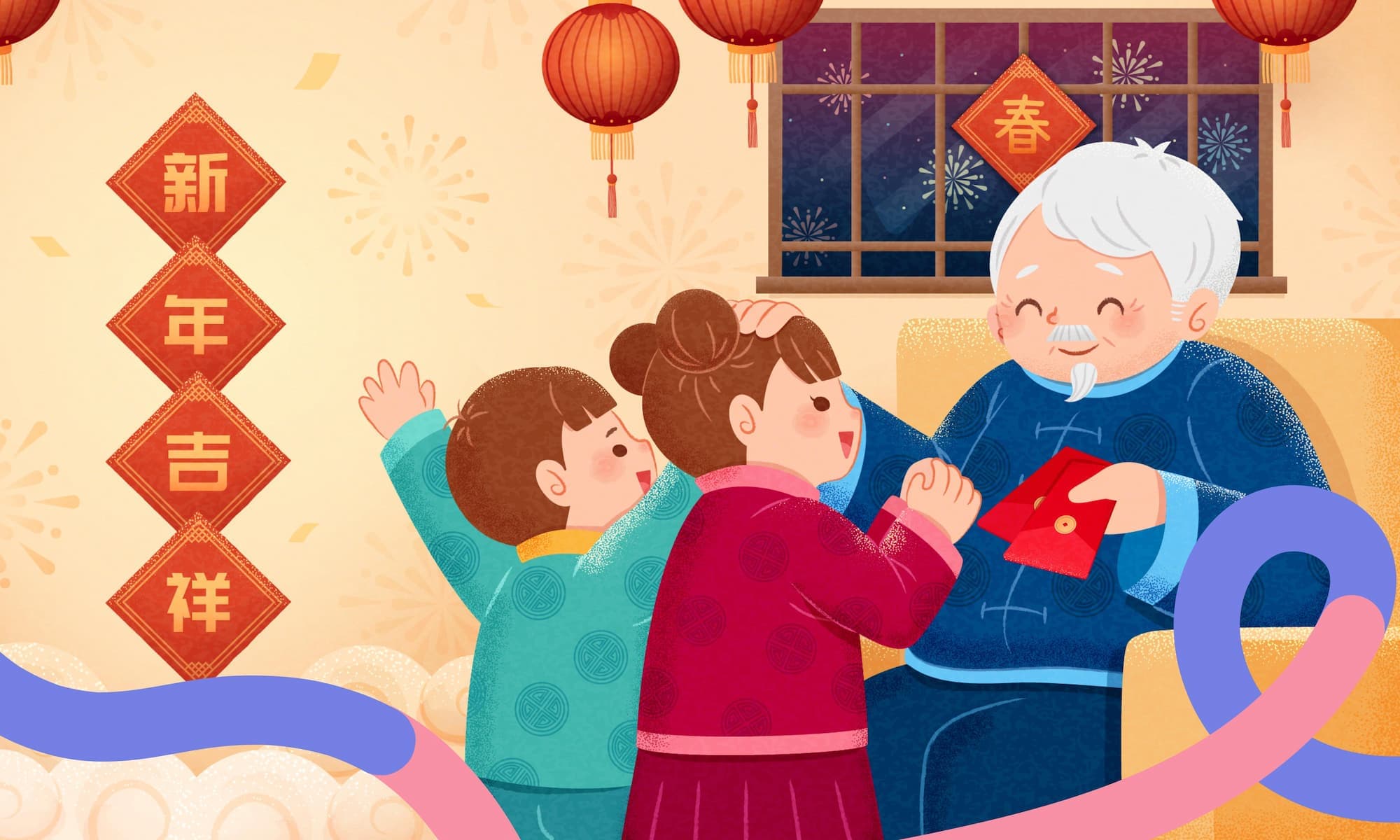
Later that night, we finally reached the moment Leo had been vibrating with excitement for: the Red Envelopes (Hóngbāo 红包). But before I handed one over, I pulled him onto the sofa. I wanted him to understand that these Spring Festival traditions are about more than just money—they have a backstory.
So, I told him the Legend of Nian. I described the scary beast that used to haunt villages and how the people discovered its only weaknesses: the color red and loud noises. Leo sat there, totally captivated, realizing for the first time that the red packet in my hand was a symbol of protection, not just a wallet filler.
"So, the red couplets on the door and the red envelopes aren't just decorations?" he asked.
"Not exactly," They are the first line of defense. In Spring Festival traditions, pasting Red Couplets (Chunlian 春联) is our way of guarding the home. The red color keeps the beast out, while the poetic verses written on them invite good fortune in."
This narrative context changed his perception of the Red Envelope. It was no longer just a transaction of cash; it was a token of protection and love from the elders to the younger generation—known as Yā Suì Qián 压岁钱 (money to suppress the evil spirits).
Then came the rehearsal. I explained that with this particular Spring Festival tradition, a casual "thanks" wouldn't cut it. I taught him to accept the envelope with both hands and to trade it for a blessing—like "Gōng Xǐ Fā Cái" 恭喜发财 (Wishing you prosperity) or "Shēn Tǐ Jiàn Kāng" 身体健康 (Wishing you good health).
He took it surprisingly seriously. He repeated the phrases over and over until he got them right, sensing that the extra formality wasn't just about rules; it was his way of showing respect. This etiquette is a core value embedded deep within Spring Festival traditions.
We often hear that Chinese culture is deep, but you don't truly feel it until you try to pass it down. In the quiet weeks after the celebration, I saw how these Spring Festival traditions had actually shaped Leo. The shift was subtle—no overnight miracles—but it was real, and it gave me a roadmap for how to handle bilingual parenting moving forward.
Before this, getting Leo to remember holiday vocabulary felt like pulling teeth. It was just homework. But once we started actually living these Spring Festival traditions, the words just stuck. He wasn't just memorizing "Jiǎozi" from a flashcard; he was remembering the squishy dough and the messy flour. He didn't just recite "Yú"; he linked it to the wish for leftovers. I realized that Spring Festival traditions give words a home. They turn abstract sounds into real memories. When kids live the language, they learn it.
Perhaps the most rewarding outcome was observing Leo’s interactions with his peers. In previous years, he might have been reticent to discuss his heritage. This year, armed with the stories behind the Spring Festival traditions—the Legend of Nian, the sweeping of dust, the symbolism of the fish—he was eager to share. He took a set of red paper squares to school and explained the "Fu" character to his classmates. Mastering these Spring Festival traditions gave him a sense of ownership over his identity. He wasn't just "different"; he was the bearer of a fascinating, ancient culture.
As parents, we often fall into the trap of lecturing. "Do this because it is tradition." However, this experience taught me that the "why" is far more powerful than the "what." By weaving the Spring Festival traditions into narratives—stories of beasts, homophones, and wishes—the culture became accessible and enchanting. It shifted the dynamic from compliance to curiosity.
Spring Festival traditions are more than just annual customs; they are the red thread that binds us to our ancestors and connects us to the future. For families living overseas, these traditions are the anchor that keeps our children grounded in their identity, even as they navigate a globalized world.
The most beautiful realization was that Spring Festival traditions are not static relics to be preserved in a museum; they are living, breathing practices that grow with our children. They offer a unique pathway to learning Chinese—not as a foreign subject, but as a heritage language rich with wisdom.
Igniting a passion for learning begins with stories and traditions. To guide learners further on this path of discovery, where language learning meets cultural immersion, LingoAce stands as an invaluable resource. The curriculum extends beyond standard textbooks, utilizing the power of storytelling and cultural context—much like the Spring Festival traditions themselves—to make learning Chinese a joyful and meaningful adventure for your child.