
LOG IN
Book a Free Trial
The Least Common Multiple (LCM) of two numbers is the smallest positive integer that both numbers divide exactly. Knowing how to find the LCM is important not just for tricky math questions but also for real-life tasks like scheduling, working with fractions, and solving competitive exam problems. The formula that connects LCM and the Greatest Common Divisor (GCD) is: LCM × GCD = product of numbers.
👉 Quick Links: Definition | Formula | Methods | Examples | FAQs
The Least Common Multiple (LCM) of two numbers is the smallest positive integer that both numbers divide without leaving any remainder. In other words, it is the lowest number that appears in both numbers’ list of multiples. For example, if you need a number that is exactly divisible by both 5 and 7, their LCM provides that answer. LCM of a and b is the smallest number that is a multiple of both. This concept is vital in mathematics because it helps to solve problems involving synchronization, arranging things in groups, or finding common time intervals. The LCM is also used to determine the lowest common denominator when adding or subtracting fractions, making it an essential idea in number theory and everyday problem-solving.
Mathematically, the Least Common Multiple (LCM) is found by identifying the smallest number that appears in the list of multiples for each given number. For example, consider the numbers 4 and 6. The multiples of 4 are 4, 8, 12, 16, and so on, while the multiples of 6 are 6, 12, 18, 24, and so forth. By comparing these lists, you’ll see that 12 is the first number that is common to both. Thus, the LCM of 4 and 6 is 12, making it the smallest number both can divide without any remainder.
Multiples of 4: 4, 8, 12, 16, …
Multiples of 6: 6, 12, 18, 24, …
LCM(4,6) = 12, as 12 is the first number in both lists.
The formula to find the Least Common Multiple (LCM) of two numbers, a and b, is: LCM(a, b) = (a × b) / GCD(a, b) This formula uses the greatest common divisor (GCD) of the two numbers. First, multiply the two numbers together. Then, divide the result by their GCD. This method is quick and avoids listing multiples or full prime factorization, making it a popular choice, especially for larger numbers or when the GCD is already known. It ensures the LCM is always the smallest positive integer that both a and b can divide without leaving a remainder. Example: For 8 and 12, LCM = (8×12) / GCD(8,12) = 96/4 = 24.
There are three common methods to find the LCM of two numbers. Each method always leads to the same result but uses a different logical approach.
The prime factorization method finds the LCM by breaking numbers into their prime factors, then combining these factors smartly. Steps:
Find the prime factors of each number.
Take the highest power of each prime present in any number.
Multiply these highest powers to get the LCM.
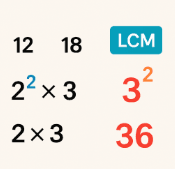
Example: For a=12a=12 and b=18b=18, 12 = 22×322×3, 18 = 2×322×32. Take the highest powers: 2222 and 3232, and multiply: 4×9=364×9=36. So, LCM(12, 18) = 36.
The ladder method is a step-by-step way to find the LCM by dividing numbers using common prime factors. Steps:
Write the numbers side by side and draw an L shape around them.
Divide the numbers by the smallest prime that divides at least one number. Write the prime to the left.
Write the results below the numbers. If a number is not divisible, bring it down unchanged.
Repeat dividing by prime numbers until all numbers become 1.
Multiply all the divisors on the left to get the LCM.
Example: Find LCM of 12, 15, and 20:
Divide by 2 → 6, 15, 10
Divide by 2 → 3, 15, 5
Divide by 3 → 1, 15, 5
Divide by 5 → 1, 3, 1 Multiply divisors: 2 × 2 × 3 × 5 = 60, so LCM = 60.
Best for small numbers:
Write out the first few multiples of each number.
Find the smallest one that appears in both lists.
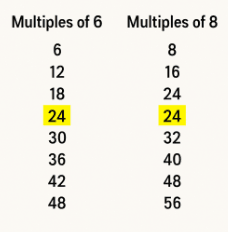
Example: For 6 and 8:
Multiples of 6: 6, 12, 18, 24, 30, …
Multiples of 8: 8, 16, 24, 32, …
LCM = 24
Let’s solve some examples step by step. Example 1: Find the LCM of 24 and 36.
Prime factors: 24 = 2³ × 3¹; 36 = 2² × 3²
LCM = 2³ × 3² = 8 × 9 = 72
Using formula: (24 × 36) / GCD(24,36) = 864/12 = 72
Example 2: Find the LCM of 4, 5, and 6 (Ladder method).
Divide by 2: 4,5,6 → 2,5,3
Divide by 2: 2,5,3 → 1,5,3
Divide by 3: 1,5,3 → 1,5,1
Divide by 5: 1,5,1 → 1,1,1
LCM = 2 × 2 × 3 × 5 = 60
Example 3 (Application): What is the smallest number divisible by both 8 and 12?
LCM(8, 12) = 24
The Least Common Multiple (LCM) is always greater than or equal to both numbers. It can never be smaller than either number.
If one number divides the other exactly, the LCM is the larger number. For example, LCM(6, 12) = 12.
The product of the LCM and the Highest Common Factor (HCF or GCD) of two numbers equals the product of those numbers. That is, LCM × HCF = product of numbers.
LCM is widely used in working with fractions to find common denominators, in comparing and simplifying ratios, and in planning schedules or events that repeat over different time frames.
Understanding these properties helps in efficient problem-solving in mathematics and real-world applications such as timing, grouping, and resource allocation.
Q1: What is the Least Common Multiple? The Least Common Multiple (LCM) is the smallest positive number that is divisible by two or more numbers. For example, the LCM of 4 and 5 is 20 because 20 is the smallest number both 4 and 5 divide into without a remainder.
Q2: What are the methods to find LCM? The three common methods to find LCM are prime factorization, division (ladder) method, and listing multiples. Each method helps you find the same result but approaches the problem differently.
Q3: Can LCM be smaller than the numbers? No, the LCM cannot be smaller than either of the numbers. It is always equal to or greater than the largest number because the LCM must be a common multiple of all numbers involved.
Q4: How is LCM different from GCD? LCM is the smallest number that two or more numbers divide into, while the Greatest Common Divisor (GCD) is the largest number that divides two or more numbers. LCM focuses on multiples, and GCD focuses on factors.
Q5: What is the LCM of the first 10 natural numbers? The LCM of the first 10 natural numbers (1 to 10) is 2520. It is a unique value frequently used in advanced math problems. [See detailed explanation here]
Explore more about LCM and related concepts to deepen your understanding:
How to Find LCM (2 numbers & 3 numbers)
LCM by Division Method
HCF and LCM Formula
LCM of Even Numbers / Odd Numbers
LCM and GCD
These resources will help build a strong foundation and keep you engaged with relevant topics. What is Least Common Multiple? The Least Common Multiple (LCM) of two numbers is the smallest positive integer that both numbers divide without leaving a remainder. For example, if you want a number that's exactly divisible by both 5 and 7, their LCM gives you that answer. LCM of a and b is the smallest number that is a multiple of both. This concept is vital in mathematics because it helps to solve problems involving synchronization, arranging things in groups, or finding common time intervals. The LCM is also used to determine the lowest common denominator when adding or subtracting fractions, making it an essential idea in number theory and everyday problem-solving.
Want to master LCM and other math concepts? Book a Free Math Trial Class with us and boost your confidence in solving problems fast!